Stretching from Pharos Street to Victoria Street, explore Queen’s Terrace, one of the oldest areas of Fleetwood which contains some amazing buildings. Follow the coast road around and The Esplanade becomes Queen’s Terrace adjacent to Pharos Lighthouse, and continues until it becomes Dock Street on the corner of Victoria Street at the Steamer pub.
Have a look around this historic area of the town –

Enjoyed this video? Why don’t you subscribe to the Visit Fylde Coast YouTube channel, for loads more great content!
Look around Queen’s Terrace
First of all, thank you to Richard Gillingham, Trustee at Fleetwood Museum and immensely knowledgeable local historian. Richard started us off with some fascinating information about the life and times of this impressive waterside street.
Fleetwood Museum, formerly the Custom House, Council Offices, Town Hall and private school is the oldest building. Some wonderful original features have been discovered, hidden inside the building.
In the grand stone terrace lived at times, Decimus Burton, Frederick Kemp (the business saviour!), Sir Peter Hesketh Fleetwood, Owen Alger (his London based solicitor) and possibly the richest man in the story, John Abel Smith. His son, Hugh Colin Smith, later became Governor of the Bank of England and retained much property in Fleetwood. Later, The Estate Company controlled Fleetwood’s 20th century expansion from there.
Companies like the North Lancashire Steam Navigation and London and North Western Railway has business premises there. The Ellison’s (owners of Parrox Hall, Knott End) established a Temperance Hotel there before 1845.
FREE Newsletter
FREE Newsletter

In the terrace at various times were private schools, an early private hospital and consulates for foreign nations, including Holland.
One house still has amazing features from 1842 including the original kitchen (with cooking ranges, fitted cupboards, stone floor and pantry). It has grand rooms, a Victorian dressing screen, servant bell pushes and living quarters.
Notable Buildings at Queen’s Terrace
Upper Queen’s Terrace, also known as Stone Terrace – pictured above. This was begun in 1836 and complete by 1844 to a design by Decimus Burton in the English Classical style.
Constructed of stone with slate roofs and standing three storeys high, the houses were built as residences for the leading inhabitants of the town including Sir Peter himself, his agent Frederick Kemp, his architect Decimus Burton, and businessman John Abel Smith.
Houses here were let out for months at a time to rich families as summer holiday lets. For example the Birleys of Kirkham – maybe they used them as ‘holiday homes’ for the summer.
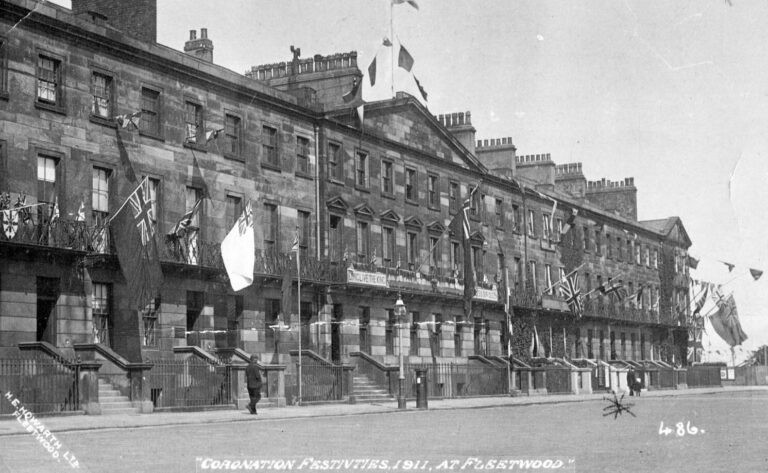
The Fleetwood Estate Company was formed in 1875 to take over Sir Peter’s property. At one time they occupied the property nearest to Pharos lighthouse.
During the Second World War a number of the properties were used as Consular Offices. Here in Fleetwood they represented over-run countries on the continent whose fishing fleets found safe harbour in the port during the hostilities. Once the war ended they were renovated and converted back into private residences. However, most of them were converted into flats rather than remaining as complete houses.

South of Kent Street
Lower Queen’s Terrace, or Brick Terrace, is the row of smaller but just as attractive houses, which Decimus Burton also designed.
Richard Gillingham tells us “Several of the houses still have original features – staircases, kitchen cooking ranges in the cellar, original sinks and copper/boiler for washing clothes, servants bell pushes some have early toilet bowls. These houses would originally employed one or more servants. The houses had pavements in front with coal holes set into them. Look carefully when you pass – some are still visible.
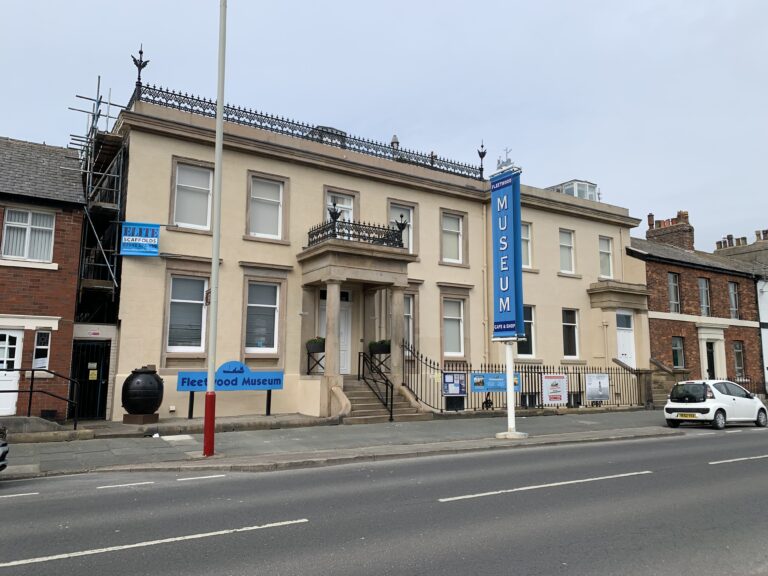
Fleetwood Museum occupies Fleetwood’s oldest complete building, originally the Custom House. Opened in 1838 it’s one of the oldest buildings still in use today. Find out all about the history of Fleetwood Museum here.
The Steamer at Fleetwood was opened as a public house in late November 1840 by John Dobson of Garstang. Then Fleetwood’s third pub, it’s now the oldest one in the town.
The doorways/windows and frontage of The Steamer originally matched the houses alongside, with ornate signage above the gutter line. The large doorway and the large bay windows to Queens Terrace were later additions. Sir Peter Hesketh Fleetwood and Lady Fleetwood stayed at the Steamer during official visits in the 1850s, when he was residing in the South. At this time his financial situation was much weaker.
Named after the Ardrossan to Fleetwood Steamer, at the back of the hotel were stables and an ostler’s workshop (an ostler is someone who takes care of the horses at an inn).
The Stone Terrace
Richard Gillingham explains “Several houses in the Stone Terrace still have the almost complete cast iron cooking ranges from the 1840’s. At least one has its original well. The house on Kent Street corner has an original coach house stable at the rear. A personal recollection of my late Mum, Norah – around 1927 she attended a birthday party of a classmate in the Stone Terrace. The first floor lounge was so big that a trio played for ballroom dancing!
Really it is a miracle that the property survives. Grand terraces in bigger towns than FLEETWOOD have long since lost similar ones. The property gives many clues as to the original prospects for the town and the lifestyles of those early important figures.”
Bleasdale Court
According to Kris Butler, Bleasdale Court is numbers 21 to 24 in Upper Queen’s Terrace. They were derelict and purchased in 1969 by a Mr Metcalfe. He paid £5000 for all four houses and converted them to 20+ flats which were sold-off as separate units. 16 to 20 and 25/26 are still on single title deeds and are in single ownership. 25 and 26 were the Grosvenor Hotel and Restaurant, converted in 1970. 27 to 29 was also converted around this time and sold off.
Kris reports “The chimneys were in a bad state, as are the ones still remaining on the building – which is why some have been removed. They are built with Fleetwood birch which very soft. With the weather in Fleetwood they did well to last as long as they did.
“The block is listed Grade 2 as it’s a unique design by Decimus Burton. However the council have allowed some of the houses to remove dormer windows off the front, chimneys, fit different windows and horrible glass front doors. It really is a shame. However I am pleased to say that I own one and am restoring it back to a period house with sash windows, servant bells and a NEW CHIMNEY  “
“
Queen’s Terrace in the 1800’s
Brenda Shaw sent us this image of a print which was on the wall in her mother’s apartment – she was interested in the history of the building in which she was so happy to live. You can see Queen’s Terrace in the left of the picture and an early Fleetwood railway station.
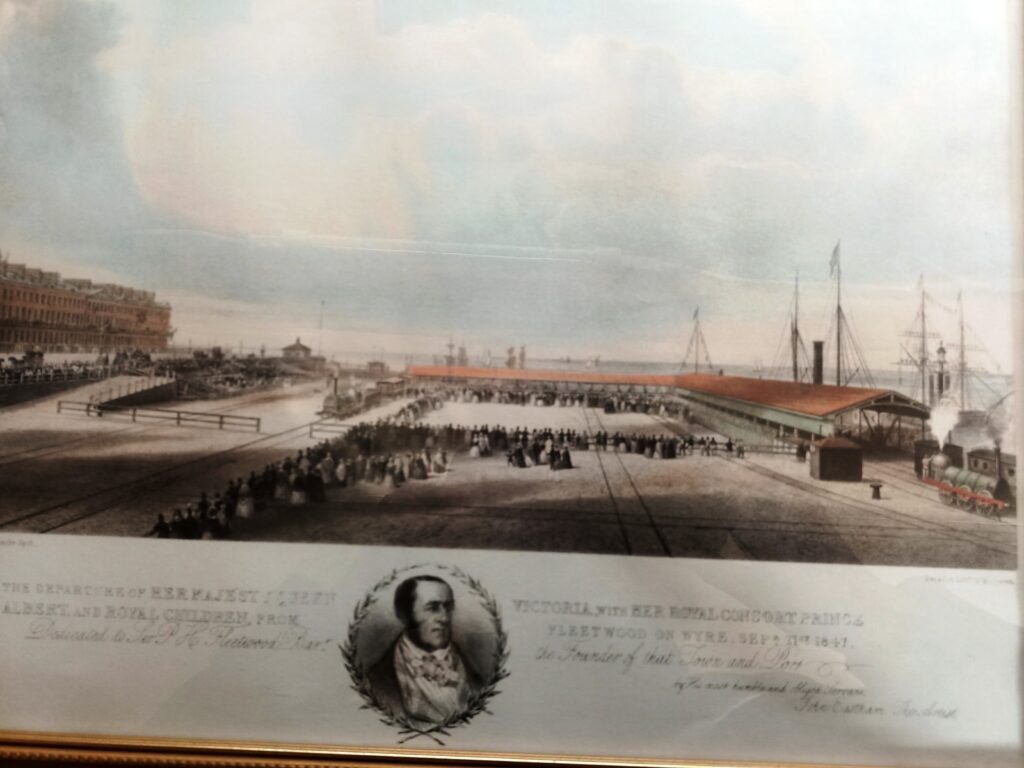
Richard Gillingham explains “The print was of Queen Victoria’s visit on September 20th 1847. The Royal train was not in a station then – just an extended goods line with temporary steps into the train. In 1847 the rail line into Fleetwood was on the edge of the river from Burn Naze, with the line being carried over a wooden structure to the Dock Street terminus. By 1851 The line was re routed in came into Fleetwood by a more Westerly route to Dock Street.
The Royal Yacht is at the quay. Alongside the yacht is the temporary gilded temporary pavilion used to welcome the Queen ashore.
The land at Queen’s Terrace on which the 1883 station was built was originally timber yards and saw pits for Gibson’s Shipyard – originally where the coastguard RNLI now is.
The stone terrace is a hugely significant building historically – and in many other towns, it would be far better known! Many of Decimus Burton’s terraces accredited to him around Regents Park in London were in fact erected with influential figures. Like an early mentor John Nash and Decimus’s father James- one of the wealthiest developers in London.
Queen’s Terrace and the Railway
Tony Morris from Hinckley in Leicestershire emailed to point out that there have been three railway stations at Fleetwood.
- 1840 to 1883 – Dock street.
- 1883 to 1966 – Queens Terrace.
- 1966 to 1970 – Wyre Dock was renamed Fleetwood.
The railway came to Fleetwood in 1840 with a main passenger station at Dock Street opposite the Crown Hotel (now Pennine View) on Church Street. At the south end of Queen’s Terrace was a good station.
Originally known as Burton’s Houses, this impressive building had been renamed in honour of Queen Victoria’s visit in 1847. George White opened Queen’s Terrace when it was completed in 1848. He was a silhouettist and photographer who lived in the last house at the north end of the new terrace.
The Dock Street station was replaced in 1883 by the second Fleetwood Railway Station, opened on 15 July alongside the Steamer Pier at Queen’s Terrace. It was one of only five ‘First Class’ stations in Britain and eventually closed on 18 April 1966.
An early problem for residents and visitors on Queen’s Terrace, was the unmade roadway. Visitors through the early Railway Station complained about the muddy surface in winter and dust in summer.
MANY THANKS also to Nick Moore and his fascinating History of Blackpool for some of the historical information used in this page.
While you’re here…
Go to the homepage of the Visit Fleetwood website for the latest updates.
Love the Fylde Coast? Sign up for your email newsletter. Packed full of interesting things it arrives in your inbox all 52 weeks of the year.
Join us on Facebook at our Visit Fylde Coast Facebook Group and follow us on Twitter @visitFyldeCoast
Plus hundreds of videos to watch on our YouTube channel – from all over the Fylde Coast!
Booking a stay? Pick a safe, clean and legal place to stay, at the very best price. Book with the Visit Fylde Coast and StayBlackpool guide.

We Need Your Help
We Need Your Help